For the early adopter, ‘Not your keys, not your coins’ was the only way to keep your Bitcoin safe. Bitcoin holders lived through the exchange collapses and the accidental burns of 2013. But things have changed in 2026. For large, long-term holdings, the answer increasingly is yes – a Bitcoin bank is safer than a hardware wallet, but only when the bank’s architecture eliminates the failure modes that sank the likes of Bitfinex, QuadrigaCX, and FTX. Ultimately, architecture is the deciding factor, rather than the label.
As Bitcoin wealth has matured, the weight of being the only point of failure has become a liability. The question for the modern veteran is no longer just ‘Who owns the keys?’ but ‘Can I really trust myself with a life-changing secret?’
Bitcoin bank vs hardware wallet: The veteran’s choice
Choosing between a Bitcoin bank vs hardware wallet has traditionally been a choice between total dependence and total isolation. A bank offers institutional safety but demands your permission; a hardware wallet offers freedom but demands your absolute perfection.
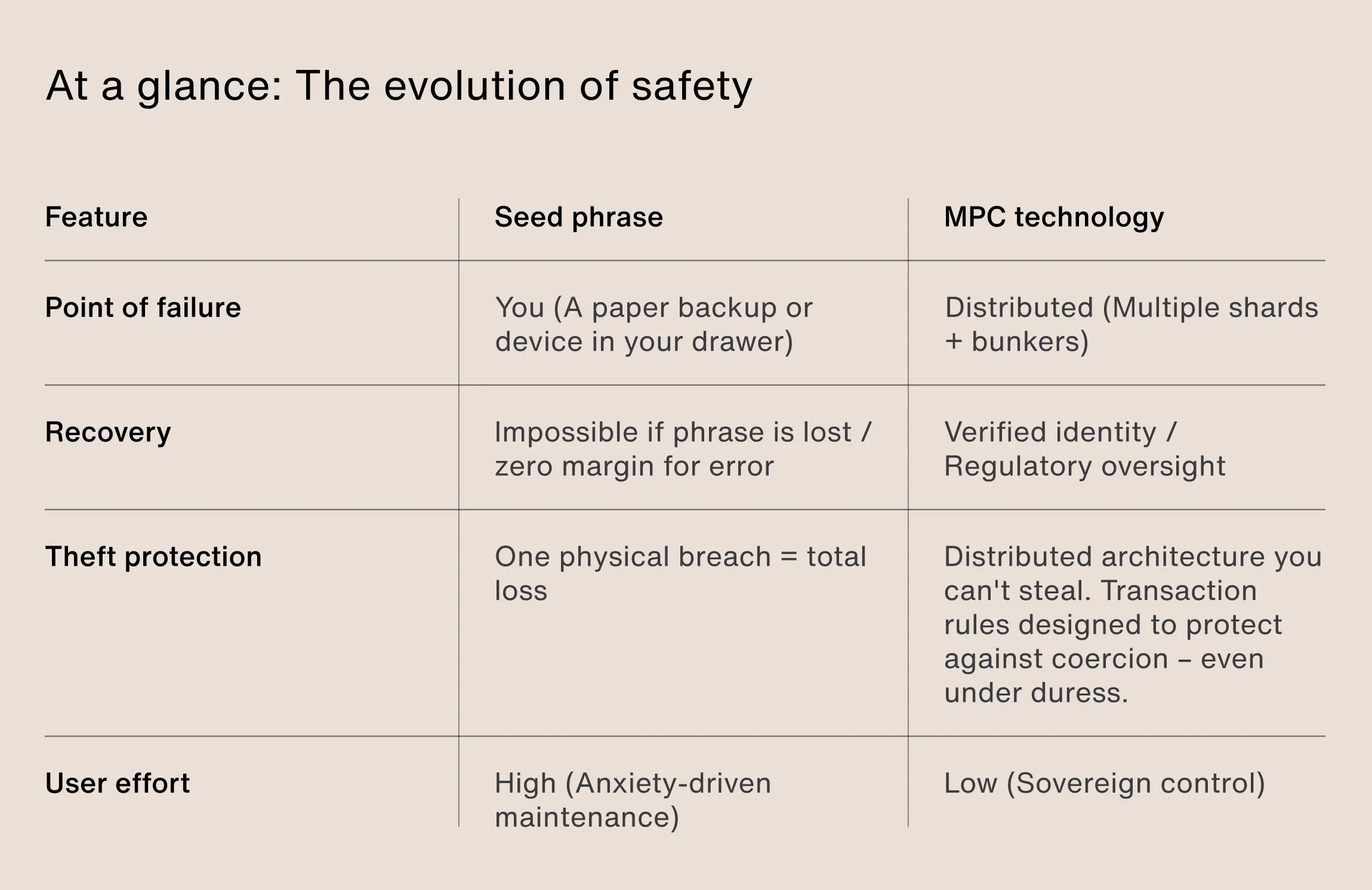
You need your Bitcoin to be accessible and usable without worrying about maintaining complex infrastructure independently and constantly assessing risks of exploits as an individual. This is where MPC (Multi-Party Computation) bridges the gap, offering robust security without the vulnerability of a physical seed phrase.
What is the difference between a Bitcoin bank vs hardware wallet?
A Bitcoin bank (a regulated custodian) offers the comfort of a familiar institution. Regulated custodians absorb the weight of custody, but their varying architectures offer different levels of protection. While some custodians implement advanced controls like Multi-Party Compute (MPC) technology, which ensures that private keys never exist in their entirety, others may still rely on legacy approaches that put your holdings at risk.
A hardware wallet puts the keys in your hand. It’s the difference between renting a safe deposit box and owning the safe itself. In 2026, the choice isn't just about ‘who do you trust?’ but ‘how fast do you need to move?’
What are the self-custody risks in 2026?
The self-custody risks in 2026 have become deeply psychological.
Sophisticated phishing: Scams are more personal and polished than ever.
Physical security: A hardware wallet is only as safe as the room it’s in.
Security fatigue: Managing complex multisig setups and the stress of being your own bank can lead to errors.
The ‘one-mistake’ trap: As Bitcoin’s value increases, a single misplaced paper backup or a physical wrench attack is all that leaves between your wealth and zero Bitcoin.
The inheritance gap: If only you can navigate the security to your keys, your family is left in the dark if the unthinkable happens.
What is the best way to store large Bitcoin amounts?
The best way to store large Bitcoin amounts today is through a model that balances MPC (Multi-Party Computation) with physical, military-grade redundancy. MPC-CMP removes the single-point-of-failure risk of the seed phrase. Because the full private key is never assembled – not at creation, not at signing, not ever – there is no complete key for an attacker to steal. Shards refresh automatically and are held across geographically dispersed, air-gapped locations, so compromise of any single shard yields nothing usable.
By moving to a regulated, vault-based Bitcoin custodian, you maintain legal ownership while shedding the technical burden of seed phrase management. Rather than giving up control, you’re gaining the freedom to sleep soundly, knowing your legacy is protected by over a decade of operating history.