You have spent years accumulating Bitcoin, building a legacy in the hardest money on earth. You’ve weathered the volatility and stayed the course, but you are likely carrying a quiet, practical concern that could compromise everything you’ve built: a twelve-word seed phrase hidden in a place your spouse might not find, or involving technical steps your children don't yet understand.
The truth is, Bitcoin inheritance is less of a technical challenge and more of a human one. For years, the industry standard has been that being your own bank requires accepting a system where a misplaced backup or a single lapse in memory results in assets becoming permanently inaccessible. This creates a yield void where your wealth sits idle, shadowed by the persistent worry that it might never actually reach the next generation.
As we move through 2026, the goal for the long-term Bitcoin holder has shifted. This guide provides a straightforward framework on how to protect your legacy, securing your family’s future through a process that is both legally recognised and easy for your heirs to navigate.
The Reality of Self-Custody Risks in 2026
In the early days, managing your own keys was a badge of honour – a symbol of ultimate financial sovereignty. But for some, that badge is starting to feel heavy. The landscape of self-custody risks in 2026 has evolved. While we once focused primarily on technical security and dodging hackers, the more pressing concern today is the simple, fragile nature of human life.
True security is as much about letting the right people in when the time comes, just as much as it is keeping people out. If your family’s wealth depends entirely on your ability to maintain a complex security protocol, it becomes a liability. Passing on Bitcoin safely should not be a technical hurdle. It shouldn't require your grieving family to become cybersecurity experts during their most difficult days, struggling to recover the very assets you spent a lifetime building.
What happens to my Bitcoin if I lose my hardware wallet and die?
If you die and your hardware wallet is lost or inaccessible, your Bitcoin is permanently unrecoverable, as the cryptographic nature of the blockchain offers no centralised reset mechanism. Without the private keys or a pre-established Bitcoin succession framework, those assets remain locked on the ledger forever, beyond the reach of probate or loved ones. This creates a permanent yield void, where your life’s work exists in theory but vanishes in practice. For the provider, this is a huge risk: leaving a legacy that is technically secure but functionally invisible to the very people it was intended to protect and sustain.
The Seed Phrase Vulnerability: Why "Be Your Own Bank" Fails at Death
The very thing that makes Bitcoin beautiful – its unflinching security – is what makes it a quiet danger for a family left behind. The traditional self-custody model often creates a contradiction when it comes to providing for family following death. This is a seed phrase vulnerability in estate planning. It is the realisation that the same wall that keeps the world out may eventually lock your family out too. In the effort to eliminate counterparty risk, many accumulators accidentally create a far more certain risk: the risk of technical exclusion.
Seed phrase vulnerability in estate planning
Seed phrase vulnerability in estate planning refers to the single point of failure inherent in self-custody Bitcoin management. While a 12-to-24-word recovery phrase prevents a bank from freezing your funds, it also prevents your family from recovering them in a crisis. In crypto estate planning, a seed phrase is a barrier, not a bridge. If the phrase is lost or destroyed, the Bitcoin is cryptographically locked forever, effectively removed from circulation. The wealth exists, but cannot be accessed or utilised by the next generation.
Evaluating DIY Methods vs. Institutional Solutions
When you evaluate how to pass on Bitcoin safely to the next generation, you are looking for stability just as much as you’re looking for a technical fix. Most crypto estate planning discussions focus on the ‘how’ of the technology, but the ‘who’ is more important. You need a solution that stands regardless of the market and remains accessible to your family even if they don’t share your technical expertise.
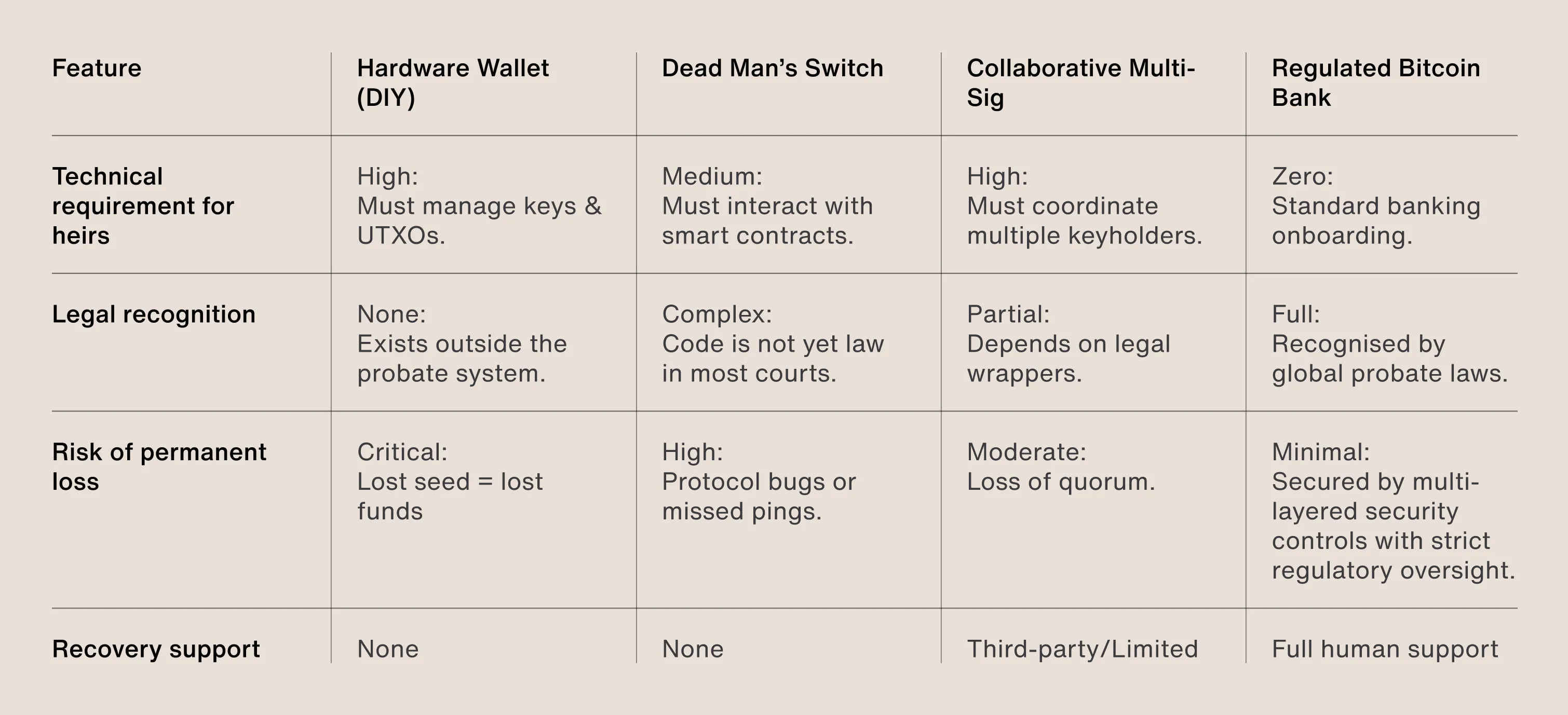
A common DIY approach often discussed in Bitcoin circles is the dead man’s switch crypto model – a system of smart contracts designed to trigger a transfer if you fail to ping the service for a set period. While this appeals to those who value automation, it introduces a new set of risks: protocol bugs, missed notifications, or the simple fact that a grieving family may not be ready to manage a sudden, automated influx of keys and coins.
Stability is built upon a Bitcoin succession framework that bridges the gap between the asset's value and the heir's ability to manage it. Without this, you risk leaving your family with a high-value asset that is effectively locked behind a wall of complexity. Moving toward a system of certainty means aligning your Bitcoin with the same legal and supportive structures that govern the rest of your estate.
Building a Robust Bitcoin Succession Framework
A successful Bitcoin succession framework doesn't rely on the mechanical fragility of a dead man’s switch crypto setup. You shouldn't have to promise to click a link in an email every six months just to keep your family’s future alive. This approach treats your life’s work as a technical chore rather than a multi-generational asset.
A robust framework for crypto estate planning should instead leverage the same established legal protections that govern your home, your land, and your traditional savings. It is about moving your wealth from the shadows of best-effort DIY setups into the light of a recognised family legacy. By integrating Bitcoin into a formal estate structure, it is treated with the same gravity as any other significant holding. This turns an on-chain mystery into a tangible, legally defensible inheritance that provides your heirs with security, clarity, and peace of mind.
Navigating Probate for Digital Assets and Digital Asset Succession
There is a comfort in the law. While the ‘be your own bank’ ethos often shuns traditional systems, the truth is that for all its slow-moving gears, the probate system is designed for one specific, vital purpose: so that what is yours becomes theirs.
For the long-term provider, the goal is to anchor it in a foundation that lasts. When you manage digital asset succession through a regulated entity, your Bitcoin stops being a dark asset existing outside the fence of legal protection.
Because a regulated institution operates within a recognised framework, it acknowledges the authority of a will and the validity of a death certificate. This creates a bridge between the cryptographic world and the physical one. Probate for digital assets becomes a standard administrative procedure rather than a technical crisis. It allows your lawyer to do their job, your executor to follow your wishes, and your family to find their footing during a time of grief without needing to understand a single line of code or hunt for a hidden hardware wallet. By aligning your Bitcoin with established inheritance laws, an easily lost digital holding becomes a durable, legally defensible family legacy.
Safe Crypto Inheritance for Non-Technical Heirs
Your spouse needn’t understand the technical ‘change’ system Bitcoin uses to track your balance, and your children shouldn't have to learn the intricacies of how to air-gap a laptop or manage a complex digital inventory. In a moment of loss, the last thing they should have to worry about is a technical manual or a command-line interface. Safe crypto inheritance for non-technical heirs removes the burden of technology entirely so they can focus on what matters.
It means that when the time comes, they don't have to interact with an unyielding protocol or a cold piece of hardware. Instead, they talk to a human being. This is the essence of collaborative custody inheritance with a human face—a dedicated guide who understands the gravity of the situation and can help them navigate the transition with empathy and clarity. It takes the technical weight off their shoulders so that your Bitcoin is a blessing, without a burden. You are providing them with a seamless path to the wealth you’ve built, supported by a relationship manager who speaks their language. In 2026, a legacy is defined by its accessibility—to the right people. It’s also the peace of mind that comes from knowing your family is supported by people, not just code.
Setting Up a Beneficiary Designation for Bitcoin
The most profound thing you can do for your family is to make your Bitcoin as easy to inherit as a common savings account. A formal beneficiary designation for Bitcoin process strips away the mystery of the blockchain and replaces it with the certainty of a legal directive. Xapo Bank helps you establish a clear path in the app, so you can transform a complex technical asset into a family legacy that respects both the protocol and the people you love.
The 2026 Bitcoin succession checklist
[ ] Identify beneficiaries: Legally document who receives which percentage of your digital wealth directly within your account.
[ ] Establish trusted contacts: Provide authorised names to notify the institution in the event of your passing, creating a human bridge to your assets.
[ ] Integrate with existing plans: Double-check that your crypto estate planning doesn't conflict with your traditional last will and testament. Include a letter of instruction so your heirs know exactly what assets exist and how to claim them through the proper channels.
Why Xapo’s Inheritance Feature is the Ultimate Solution
Xapo Bank’s inheritance features can offer legal beneficiary designation. For years, you have navigated the volatility and the noise, driven by the quiet conviction that this is the hardest money ever created. But the journey isn’t truly complete until the bridge between your digital vault and your family’s future is built, tested, and bolted down. Advanced security controls featuring Multi-Party Compute (MPC) technology ensure that private keys never exist in their entirety, with geographically dispersed key shards secured in independent, secure locations.
By choosing an institution that respects both the protocol and the law, you finally resolve that existential custody fear. With KPMG-audited financial statements and robust asset segregation, you don’t have to take anyone's word for it. You can rest easy with the mathematical certainty that the bank isn't just holding a promise; they are holding the actual, physical-digital future you built so that your wealth is there 30 years from now when your heirs need it.
You’ve spent years stacking sats with the discipline of a man who knows what the future is worth. Don't let that discipline falter at the finish line. Spend ten minutes today making sure your life’s work reaches the people you love through a process they can understand and a system that protects them. That is how you stop being just a HODLer and start being the founder of a multi-generational legacy. That is how you truly win.