Somewhere between 2.9 and 3.7 million BTC is likely lost for good, though the blockchain can’t tell us which coins. While the coins still exist on-chain, many holders have lost access due to forgotten passwords, , or deaths without inheritance plans.
Since the genesis block was mined in January 2009, more than 20.1 million Bitcoin have been issued, leaving only roughly 900,000 BTC to be released before issuance ends around 2140. But “mined” isn’t the same as “available”: beyond lost coins, governments, corporate treasuries, and ETFs have absorbed a growing share of what’s left.
So how much Bitcoin is actually available? This article sorts the supply by how likely each coin is to ever trade again, and how confident we can be at each step.
What’s left to mine?
Key figures (as of mid-November 2026)
Mined to date: ~20.1 million BTC (95.78% of the 21 million cap)
Still to be mined: ~887,000 BTC
Issued today: 3.125 BTC per block (~450 BTC per day on average)
Final coin: expected around 2140
Bitcoin’s supply schedule was programmed from the start. Miners earn newly created Bitcoin for every block they add to the chain, roughly every ten minutes, and that reward halves every 210,000 blocks (about once every four years). The block reward began at 50 BTC per block in 2009, and has been 3.125 BTC since April 2024.
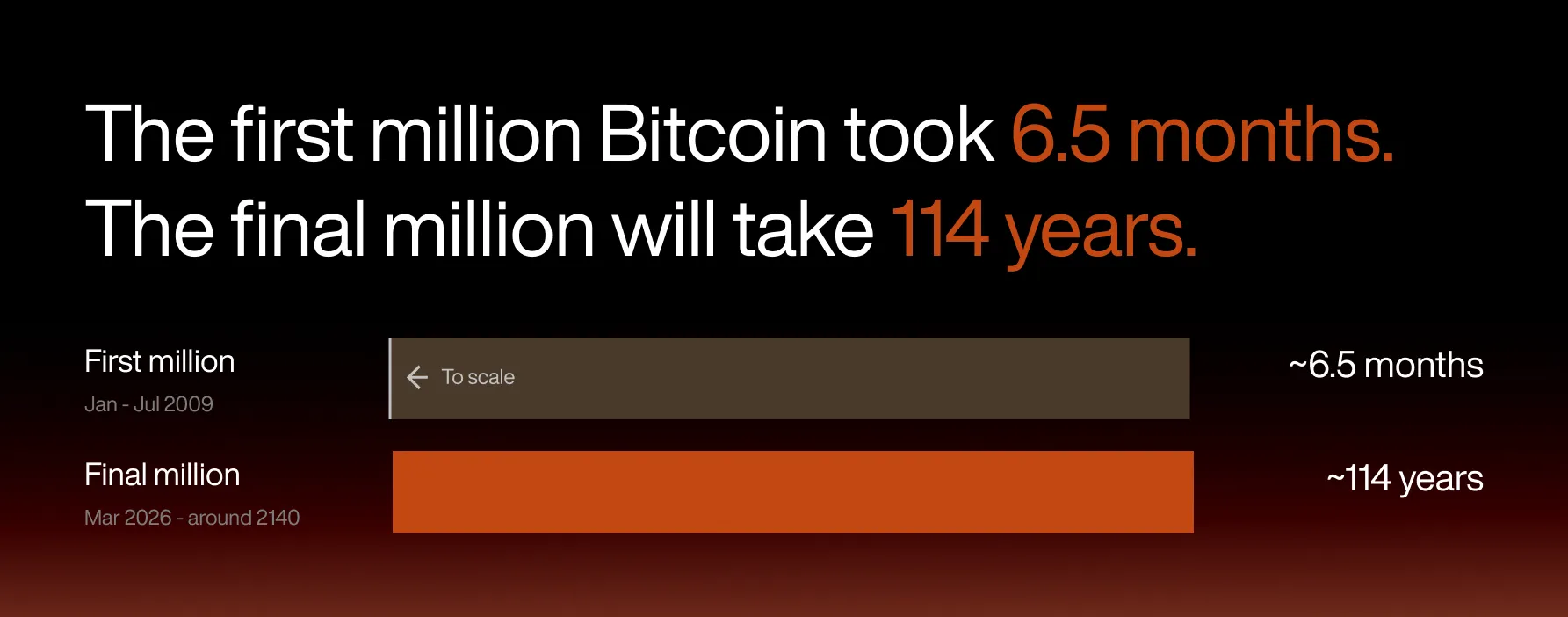
Because the reward keeps halving, most Bitcoin was issued early. The 20 millionth coin was mined in March 2026, a little over 17 years after launch, but the final million will trickle out over more than a century. By around 2035, 99% of all Bitcoin will have been mined.
This is the only figure in the article that can be counted precisely. Every coin ever created can be counted on the public blockchain, and the protocol’s schedule for remaining BTC is fixed. Once the question shifts from how many Bitcoin exist to how many could actually change hands, the industry relies on best estimates drawn from wallet activity and locked reserves.
“Lost” coins
Key figures
Provably destroyed: ~3,530 BTC (CoinGlass)
Probably lost, including Satoshi’s coins: ~2.9M–3.7M BTC (River; Chainalysis)
Attributed to Satoshi: ~1.1M BTC, almost entirely unmoved since 2010
Untouched for 7+ years: ~5.3M BTC (Glassnode). Nearly all lost-coin estimates fall within this pool.
The blockchain records which addresses hold coins, but not whether anyone still has access to the keys. As a result, an estimate of lost Bitcoin is really an estimate of which coins have stopped moving, and why.
Only a tiny amount is provably gone. CoinGlass counts around 3,530 BTC sent to unspendable burn addresses, locked in OP_RETURN outputs, or left unclaimed by miners.
The two best-known estimates of lost coins differ mainly in their methods. In 2020, Chainalysis took a broad approach, treating any coin unmoved for five years as lost, which gave 3.7 million, including Satoshi’s stash. River’s estimate, updated monthly, is more selective: it weights wallets by how long they’ve been inactive, and puts losses at about 1.76 million, or roughly 2.9 million once Satoshi’s coins are included.
Dormant isn’t the same as lost
Glassnode data shows about 3.6 million BTC hasn’t moved in more than a decade, and another 1.7 million in seven to ten years. Nearly every lost-coin estimate sits within that pool of roughly 5.3 million BTC. But dormant coins do come back. In July 2025, an investor from Bitcoin’s early years sold 80,000 BTC that hadn’t moved in more than 14 years. Long-dormant supply includes lost coins, but also patient holders, estates, and cold storage that simply hasn’t been touched.
The Satoshi question
The largest single dormant holding is attributed to Bitcoin’s pseudonymous creator. In 2013, researcher Sergio Demian Lerner identified a distinctive pattern in how many of Bitcoin’s earliest blocks were mined. His later analysis traced it to roughly 22,000 blocks, suggesting that a single miner, widely assumed to be Satoshi Nakamoto, collected around 1.1 million BTC in 2009 and 2010. Those coins are spread across thousands of separate addresses, and almost none have ever moved. Depending on how strictly the pattern is applied, the total ranges from about 0.9 million to 1.17 million BTC, and the link to Satoshi rests on circumstantial evidence rather than proof.
Nobody knows whether Satoshi’s coins are lost, deliberately abandoned or still accessible. Without them, River and Chainalysis put the number of lost coins at about 1.8 million and 2.6 million. With them, the figures rise to roughly 2.9 million and 3.7 million.
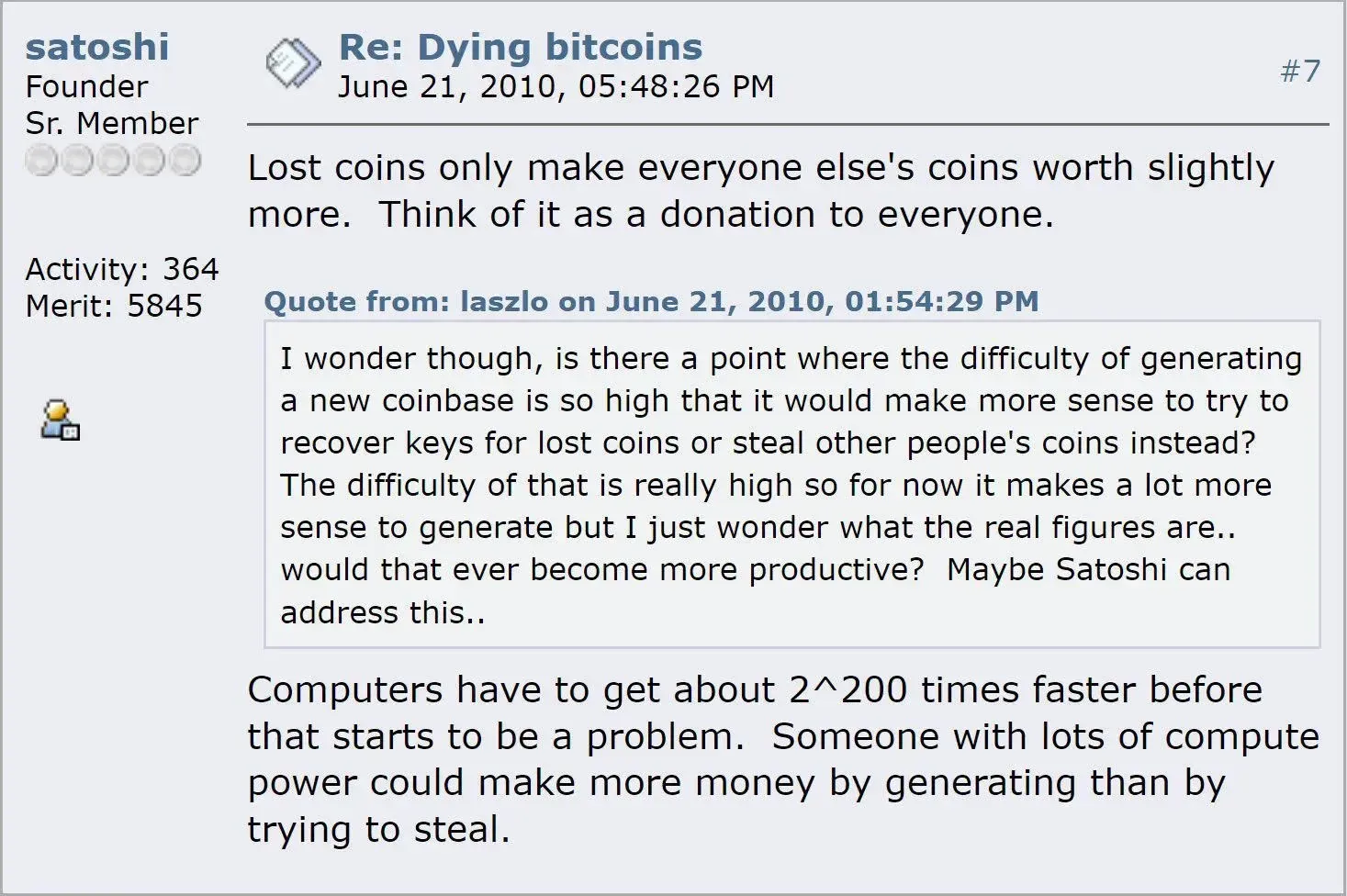
Satoshi on lost coins (Bitcointalk)
Governments: Reserves vs. seizures
Key figures
Held by governments: ~599,000–646,000 BTC
United States: ~328,000 BTC
China: ~190,000 BTC (unconfirmed estimate)
United Kingdom: ~61,000 BTC
Government holdings are easier to pin down than lost coins, but less certain than they look. Few governments publish wallet addresses, so trackers piece their figures together from court records, seizure announcements, and on-chain analysis.
Definitions vary, too. BitcoinTreasuries puts government holdings at about 645,600 BTC, but that includes roughly 46,000 BTC attributed to Ukrainian public officials. Those are personal holdings declared by individuals, not state reserves, so leaving them out brings the total closer to 600,000 BTC.
Policy vs. evidence lockers
How governments came to hold their Bitcoin matters as much as how much they hold. A few hold it on purpose. The United States created a Strategic Bitcoin Reserve in 2025 and committed to keeping forfeited Bitcoin rather than auctioning it. El Salvador buys small amounts regularly, and the United Arab Emirates has built up a reserve through state-backed mining.
However, holding Bitcoin on purpose doesn’t always mean holding it for good. Bhutan mined its way to roughly 13,000 BTC by late 2024, and in December 2025 it pledged up to 10,000 BTC to fund Gelephu Mindfulness City, a planned special economic zone. It has since sold most of its holdings and has about 525 BTC left as of 16th November.
Most government Bitcoin, though, was seized from criminals, and seized coins don’t necessarily stay put. Germany sold about 50,000 BTC over a few weeks in mid-2024. Almost all of the UK’s roughly 61,000 BTC comes from a single fraud case, and the coins remain frozen while the High Court decides how much goes to victims and how much the state may keep. Some US holdings may also be returned to the people they were stolen from. China’s often-cited 190,000 BTC comes from the 2019 PlusToken seizure and has never been officially confirmed. The coins may have been sold long ago.
Treasuries and ETFs: Held, not frozen
Key figures
Public companies: ~1.24M BTC (BitcoinTreasuries, 13th November)
Strategy: 850,849 BTC, about 69% of the corporate total (Strategy ledger, 16th November)
US spot ETFs: ~1.25M BTC (SoSoValue, 13th November)
Companies and ETFs together hold about 2.5 million BTC, nearly four times as much as all governments combined. Both hold their coins deliberately, but neither has locked them away.
Treasury companies
Corporate Bitcoin is dominated by one firm. Strategy (formerly MicroStrategy) holds 850,849 BTC, more than 4% of all Bitcoin that will ever exist and more than two-thirds of all Bitcoin held by public companies. The next largest, including Metaplanet, Twenty One Capital, Strive and MARA, each hold between about 20,000 and 45,000 BTC.
These companies typically describe Bitcoin as a long-term reserve, which is why this article treats their coins as held by policy. But 2026 has shown that policy can bend. Strategy made its first sales since 2022 in the second quarter, then sold a further 5,552 BTC in the third, mainly to fund dividends on its preferred shares and buy some of them back. MARA ended June holding 29% fewer coins than the year before.
ETFs
ETFs work differently. Trading ETF shares on the stock market doesn’t move any Bitcoin; coins only leave a fund when investors redeem their shares. Because ETF coins can return to the market that quickly, the supply map below counts them as available, but lists them separately. US spot ETFs held about 6.2% of mined Bitcoin on 13th November, roughly 1.25 million BTC, after six straight days of net outflows. BlackRock’s iShares Bitcoin Trust, the largest by far, accounts for nearly two-thirds of that.
Mapping the supply
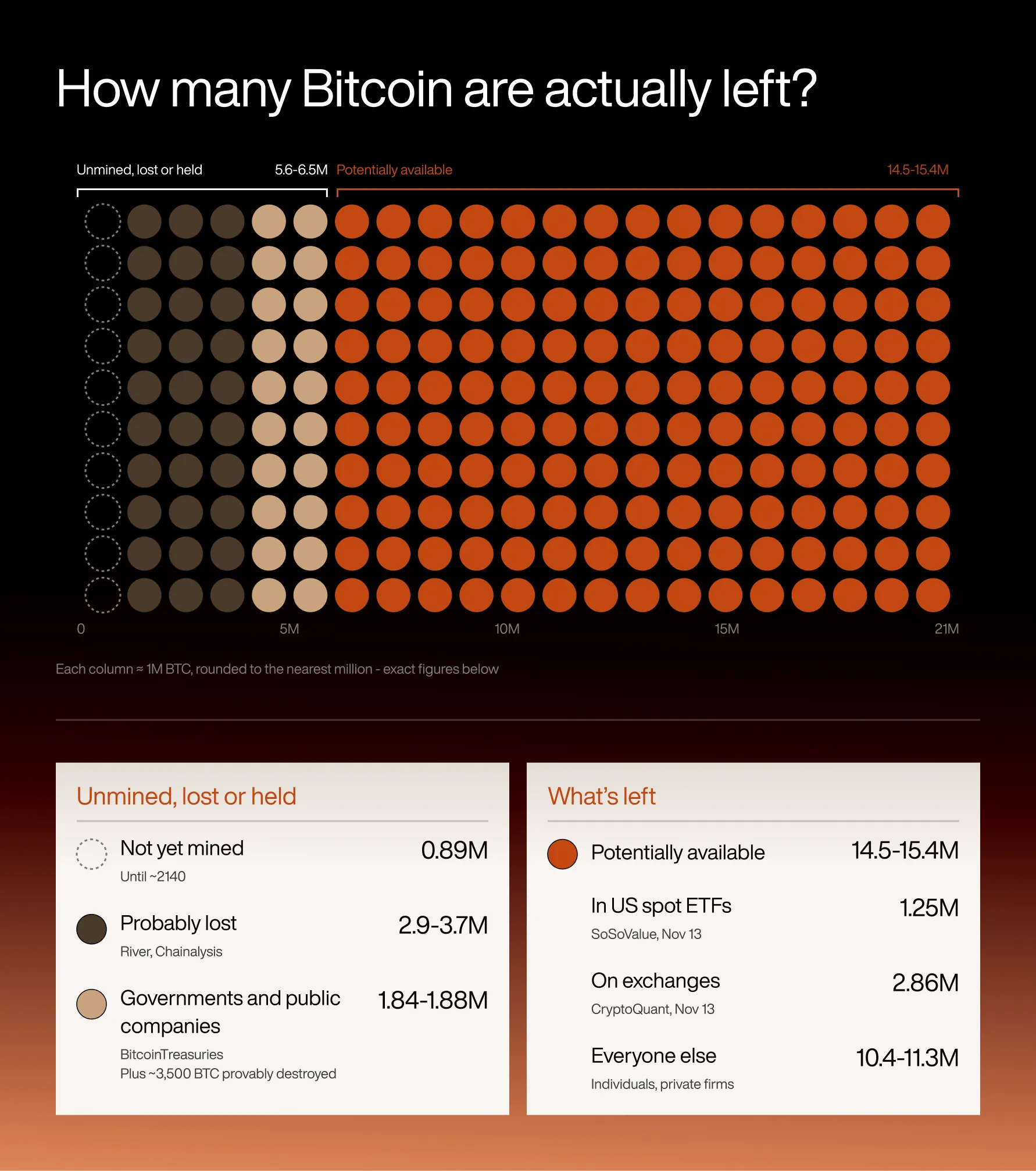
Only coins not yet mined and provably lost BTC are counted on-chain. Everything else involves judgment, which is why the answer is a range: between about 14.5 and 15.4 million BTC, roughly three-quarters of the coins mined so far, is neither lost nor held by a government or public company.
Even that overstates what is for sale. As of 13th November, about 4 million BTC sits in ETFs or on exchanges, where it can change hands quickly. The remaining 10 to 11 million belongs to everyone else: individuals holding coins in their own wallets, private companies such as Tether, funds, and custodians. It is the largest single block of Bitcoin, and the one we know least about. With millions of Bitcoin sitting inactive for more than five months, available supply may be even more constrained.
What to watch
These numbers are constantly changing, and a few developments could significantly impact supply. Coins waking up from long-dormant wallets, especially any linked to the early mining pattern attributed to Satoshi, would shrink the lost estimates. Sustained ETF inflows or outflows shift coins between the market and custodians within weeks. Meanwhile, court rulings and policy decisions, from the UK High Court to any new national reserves, will decide whether seized coins are kept or sold. And treasury companies under financial pressure could turn from buyers into sellers.
One thing is certain, however: there will never be more than 21 million Bitcoin, and for all intents and purposes, there are a lot fewer.