Bitcoin is secured by miners, who spend real energy protecting the network. Today, their main incentive is the block subsidy: newly issued Bitcoin awarded to whoever mines the next block. However, this subsidy halves roughly every four years. What keeps the network secure in fifty years, once it has shrunk to almost nothing?
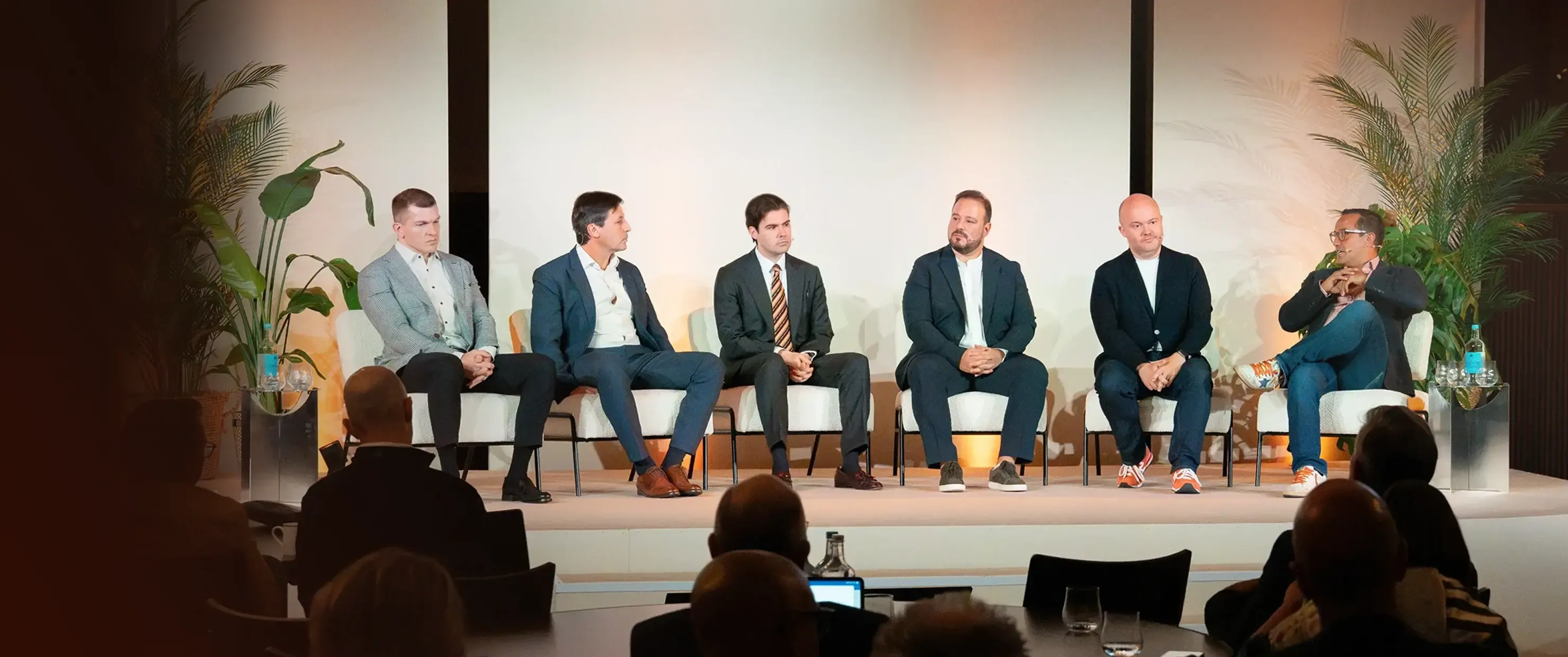
At the first Xapo Bank Summit in London, our Executive Director, Joey Garcia, moderated a panel of five builders and industry leaders who travelled from Argentina, the US, Iceland and Paraguay. Each approached the question from their own corner of the industry:
Diego Gutierrez Zaldivar, CEO and Co-founder, RootstockLabs
Zac Townsend, CEO, Meanwhile
Daniel Jonsson, CEO, MGMT Digital Infrastructure
Juanjo Benitez Rickmann, CEO, Digital Assets S.A.
Conner Brown, Managing Director, Bitcoin Policy Institute
1. Security with a physical cost
Diego Gutierrez Zaldivar described Bitcoin as both an asset and a security and trust infrastructure.
"From a security perspective, Bitcoin is the safest decentralised network in the world."
The reason, he argued, is Proof-of-Work (PoW). Bitcoin is secured by the real-world consumption of energy, layered on top of cryptography. That ties its security to physical limits and makes an attack very difficult.
Proof-of-Stake (PoS) networks, such as Ethereum, secure themselves differently: participants lock up the network's own token. Diego pointed to the flaw this creates. "You can use the market to attack the network, because you can short the asset that you're staking." An attacker can bet against the token, attack the network, and profit from its downfall.
As an asset, Diego compared Bitcoin to the platinum bar once kept in Paris to define the exact length of a metre. It is a fixed reference, with mathematically assured scarcity. In his view, the world lost that kind of monetary reference when it broke with the gold standard in the 1970s. Bitcoin restores it, with the addition of a global settlement network.
Security anchored in energy is hard to fake, and costly to maintain. Someone has to keep paying for that energy – the question is, who?
2. The fifty-year question: who pays for security?
Miners earn two things for securing the network: newly issued Bitcoin (the block subsidy), and transaction fees paid by users. The subsidy halves roughly every four years. As Daniel Jonsson noted, Satoshi expected the network to rely increasingly on fees, but today those fees look small beside the subsidy. "This has been the biggest question mark," Daniel said.
A number of catalysts could drive increased fee revenue on Bitcoin:
Fees follow builders: Daniel expects fee demand to rise due to constant innovation on the network. While he does not believe miners need cultural spikes like Ordinals to survive, he expects that kind of activity to keep arriving. In his view, fees will matter more over time, but they are not the only answer.
Bitcoin's security can be shared: Rootstock, the smart contract platform Diego co-founded, is merge-mined. Bitcoin miners secure it with the same work they already do, and every transaction on Rootstock pays fees to those miners. Diego's longer-term vision is for private settlement networks, large banks and even card networks to anchor their own transactions to Bitcoin in the same way, with their fees flowing to miners. In effect, the wider financial system would pay to use Bitcoin's security.
Watch from 17:48 · Diego on merge-mining, from 23:41
3. Who needs it to last: Bitcoin as long-horizon money
Diego likened building an ecosystem to settling a new city. You lay the grid and the core infrastructure, then persuade the first pioneers to move in and offer essential services, such as insurance and lending.
Zac Townsend is one of those pioneers, and he put it plainly: "Bitcoin is money." It is pristine collateral, a reserve currency, and a store of value.
Zac’s company, Meanwhile, is a life insurer that operates entirely in Bitcoin. Policyholders pay premiums in Bitcoin, the company makes its promises in Bitcoin, holds reserves in Bitcoin, and runs its actuarial work and audited financials in Bitcoin.
"For us, one Bitcoin is one Bitcoin, just like one dollar is one dollar. It's a unit of account… It's money in the world, not just gold in the ground."
A life insurer has to look twenty, thirty, forty, or fifty years out. Zac argued that anyone who looks through the cycle at that horizon reaches the same conclusion: Bitcoin is a different and better form of money. In his view, it would be strange for that economy to lack the institutions every other economy has, such as payment companies, asset managers, and insurers. By his figures, life insurance is a $3 trillion-a-year industry, bigger than payments.
As he put it: "Life insurance is the original hodl."
Conner Brown took the same logic a level higher. What Bitcoin is, he said, depends on who holds it:
Individuals see a tool for personal savings.
Corporations see a capital asset.
Nation-states see a reserve asset: a way to preserve wealth for their citizens and build financial resilience.
The Bitcoin Policy Institute had just returned from Asia, where a central bank asked detailed questions about how to adopt Bitcoin as a reserve. Recent conflicts, he added, are prompting a slow realisation of Bitcoin as a marker of financial resilience. His view: the nation-state chapter is still at a very early stage.
For Juanjo Benitez Rickmann, the frontier is more basic: access. Most banks in Paraguay, as elsewhere, still avoid allowing clients to buy or sell Bitcoin due to regulatory and compliance concerns. Digital Assets S.A. is working inside a regulatory sandbox. It has partnered with a Paraguayan digital bank with 2.8 million users so that clients can buy and sell Bitcoin directly from their online banking, in a closed loop.
Juanjo has spent around 14 years in the space. He has watched a proposed legal framework for Bitcoin mining stall at the government level, but now sees a new generation arriving in banking. Paraguay, he argued, also has something countries in currency crisis lack: time to build access deliberately rather than in a hurry.
An insurer writing fifty-year policies, a central bank weighing its reserves, a bank opening access to millions of clients: each entity is a long-term user of the network, and each is a calculated bet that its security will hold for decades.
Zac, from 11:47 · Conner, from 1:50 · Juanjo, from 7:28
4. How mining pays its way: from megasites to the grid
The cost side of the security question belongs to the miners, and Daniel Jonsson described an industry in the middle of a major shift. He mined his first bitcoin in Iceland in 2017. The model then was simple: secure hundreds of megawatts as cheaply as possible and build large, centralised sites.
The new model makes miners part of critical infrastructure. MGMT Digital Infrastructure already provides grid-balancing services that serve grid operators.
"Bitcoin is probably the greatest invention for grid operators and energy producers since the battery was invented."
For Daniel, this changes the security equation. We are entering an era, he said, where mining Bitcoin "is not your only source of revenue," and miners who want to survive will need that.
Push the logic further, and mining may not need to be a profit centre at all. If Bitcoin becomes as ingrained in finance as the panel expects, securing it could look more like a cost of doing business. "Nobody's making money storing their gold somewhere," he said. "It's a cost centre."
Joey pressed on a harder point: does industrial-scale mining, concentrated in large listed companies, threaten decentralisation? While he acknowledged the risk, Daniel believes the trend is reversing. He expects mining to move from gigawatt-scale megasites towards the edges of the grid, where it can use stranded energy and put its waste heat to work.
Advances in hydro-cooled mining hardware mean operators can now recapture most of the energy they use as heat. Daniel's data centres can deliver water at 75–85°C, hot enough for household heating. Mining is even beginning to move into homes.
Conner picked up the thread. Today's grids were designed in the 1940s and 50s, before computers. Energy literature from the 2000s and early 2010s dreamed of a modular demand-response system that could flex with supply. "And then Bitcoin just sort of drops out of the sky."
Governments are paying attention, he said, because grids still rely on expensive last-resort gas plants to cover demand peaks. A miner pays for power when it runs and gives capacity back the moment the grid needs it. Alongside the AI data centre build-out, mining can serve as a stabilising force for energy grids, and could decentralise the network further in the process.
Then he answered the panel's central question directly. People have long worried about who will pay for Bitcoin mining. "But it's actually going to serve as a critical function of how grids operate day to day." He expects the result to be almost boring: Bitcoin humming in the background, securing the network and keeping the grid responsive.
Daniel, from 15:25 · Conner, from 21:21
Five years out
Joey closed with a quick-fire question. In five years, will Bitcoin be invisible infrastructure, like the internet, or a reserve that sits in vaults?
Daniel: More people will be using the Bitcoin network than realise it, just as most people use the internet without understanding it.
Juanjo: A wave of new applications and systems, including ones that help governments work.
Conner: Trillions of AI agents will need to transfer value online, and early signs suggest they prefer Bitcoin.
Diego: The first mass-adoption wave, led by institutions packaging this infrastructure into simple products. "Fintech 2.0."
Zac: Neither. Bitcoin is pristine money. The next question is what Bitcoin's yield curve looks like.
A loop, not a single fix
The panel’s takeaway converges as a sustainable loop underpinning network security:
Energy secures the network.
A secure network earns the trust of savers, insurers, banks and states that plan in decades.
Their activity generates fees, and merge-mined networks add more.
Miners who also earn from the grid need less from the subsidy to keep going.
While the security budget remains one of Bitcoin's biggest long-term questions, this panel highlighted the diverse minds working across sectors to ensure the network’s long-term success.