When value moves through the crypto economy, it rarely sits in one place. It travels through a pipeline — bought on one platform, transferred through another, and parked somewhere else—and at each stop a different type of institution takes responsibility for it. The problem is that public debate compresses all of them into a single word: crypto. In reality, three very different kinds of platform sit behind most of that journey, and telling them apart is one of the most useful things a digital asset user can learn.
Three platforms, three different jobs
A crypto exchange is built for buying, selling, holding and transferring digital assets. Many are well run and regulated for specific activities, but the broad cryptoasset category carries risks bank deposits are not designed to hold — price volatility, platform or custody failure, cyberattack — and the compensation available if a platform fails is often limited or unavailable.
An e-money provider is built for payments. These firms can be excellent wallet and transfer providers, but customer funds are generally protected through safeguarding — the firm holding your money separately — rather than through a deposit-guarantee scheme. Safeguarding is not the same legal promise as a guaranteed deposit, and customers can face loss or delay if such a firm fails.
A regulated bank is built for deposit-taking, storage, savings and treasury services. Its defining feature for a customer is that eligible deposits are typically covered by a statutory deposit-guarantee scheme, up to a set limit, if the institution fails. A bank is the environment designed to hold value securely as cash — the destination, not the rail.
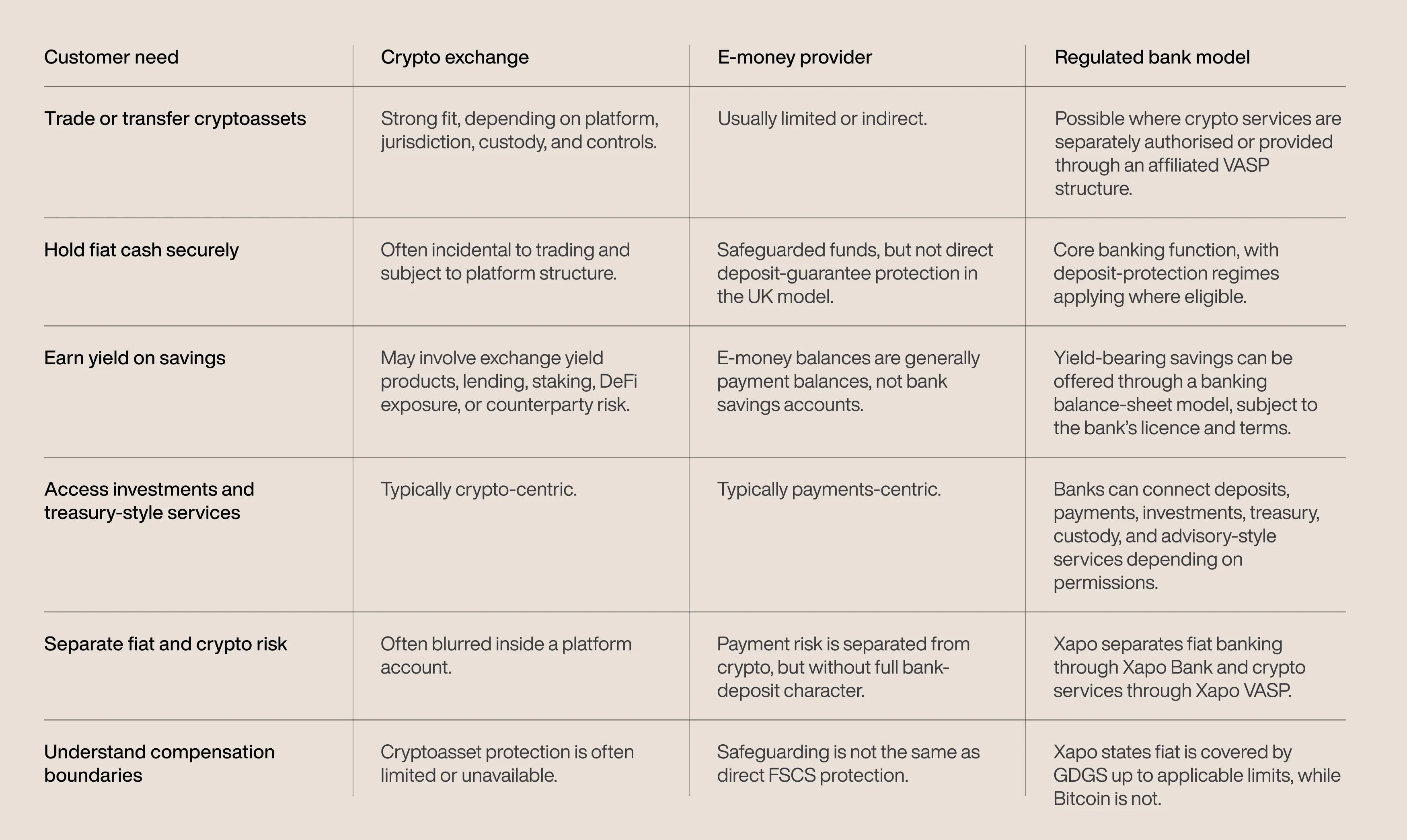
The key idea is that protection does not travel with your money as it moves between these platforms. A balance can be an unprotected crypto holding in one place, a safeguarded e-money balance in another, and a guaranteed bank deposit in a third — often within minutes, and often without the customer realising the line has been crossed. The table below sets out how the three compare against what customers actually need.
The risk lives in the handoffs
If you remember one thing, make it this: the seams between platforms are where value is most exposed. When a balance moves from an exchange into a payment app, or from a stablecoin into a bank, it briefly changes legal character — and the protection that applied a moment ago may not apply where it lands. It is also the distinction the wider banking system has historically failed to make, treating a customer pushing cash into a speculative venue and a customer pulling value out into a regulated account as the same generic "crypto risk." They are opposite movements. A mature framework reads the direction and the destination, not just the asset class. This is what we have built and operate within Xapo, an alignment on global standards converging together, years before law and regulation requires it.
Where Xapo Bank sits
Most users stitch the pipeline together from separate providers and inherit a different protection profile at every link. Xapo was built to remove those seams by combining the stages inside one coherent, regulated structure — and its design is itself a lesson in differentiation:
Xapo Bank Limited is a Gibraltar-regulated credit institution handling the fiat and banking side. Eligible fiat balances, including USD held in the account, are protected by the Gibraltar Deposit Guarantee Scheme up to the US dollar equivalent of £120,000 per member.
Xapo VASP Limited is regulated by the GFSC as a DLT Provider and handles crypto-asset services, with institutional-grade custody, 1:1 backing, and no rehypothecation, and with customer BTC held off balance-sheet and insolvency remote to the business.
That separation is the whole point. When we describe Bitcoin custody as secure, we mean technical, operational and legal security, not a deposit guaranteed. The model also reframes stablecoins as rails rather than a destination: supported stablecoins can be sent in and are converted into US dollars in a regulated account, letting a user travel from the blockchain layer to a regulated banking layer without assembling a chain of unrelated intermediaries.
Differentiation is literacy
The crypto economy is not a single place, and "crypto platform" is not a single thing. Learning to understand the difference between a crypto exchange from an e-money provider from a regulated bank that is also BTC and blockchain native — and to know which protection applies at each stop — is the core skill that lets a user move through the digital-asset world deliberately rather than hopefully. Making those distinctions explicit, and building the regulated infrastructure that respects them, is the work.