Don’t invest unless you’re prepared to lose all the money you invest. This is a high-risk investment and you should not expect to be protected if something goes wrong. Take 2 mins to learn more.
For years, the universal rule for Bitcoin was simple: buy it, put it on a hardware wallet, hide the seed phrase, and resist ever selling. But once your keys or seed phrases are safely tucked away, a more practical question begins to surface: how can you make it productive?
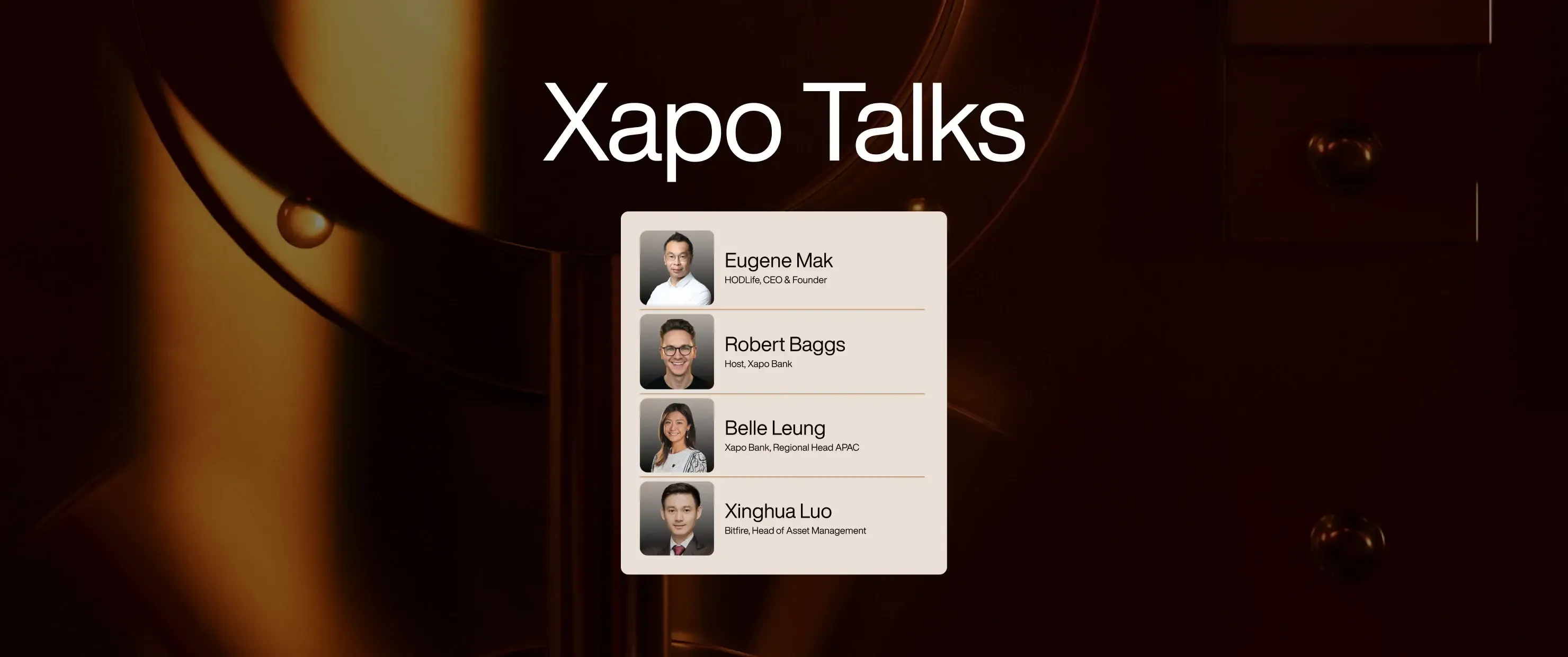
In a recent episode of Xapo Talks, host Robert Baggs (Head of Content at Xapo Bank) sat down with Belle Leung (Regional Head of APAC at Xapo Bank), Xinghua Luo (Head of Asset Management at Bitfire), and Eugene Mak (CEO of Hodl Life). Together, they broke down how serious holders are moving past basic storage: they’re aiming to earn yield, pass wealth to their children, access cash without selling their stack, and understand what protects their assets if a firm fails.
1. Investors are becoming far more cautious
The market has shifted away from the speculation of past cycles. Xinghua Luo pointed out that a couple of years ago, clients constantly asked about altcoins or whatever meme token was trending. Today, those conversations have largely disappeared.
Instead, investors are asking detailed questions about how to protect their principal and grow their core Bitcoin position. Following major industry collapses like FTX, they are no longer willing to leave funds with unvetted, offshore platforms. They want licensed, compliant managers and transparent risk controls. As Xinghua noted, investors understand the underlying mechanics before committing capital.
2. Earning Bitcoin yield without taking directional risk
Holding Bitcoin safely is step one, but leaving significant wealth completely idle isn't optimal for institutional capital. Xinghua's point throughout was that whatever strategy you choose, counterparty risk is the one that costs you your principal: the threat of an exchange failing or an operational breakdown.
With that in mind, he explained how asset managers like Bitfire generate Bitcoin-denominated returns through quantitative strategies rather than directional bets:
Funding rate arbitrage: In bull markets, eager long traders pay a periodic fee (roughly every 8 hours) to keep their positions open. Managers take the opposite side to collect those fees as income.
Basis arbitrage: Taking advantage of the price gap between spot Bitcoin and quarterly expiring futures contracts, capturing the difference as those prices converge.
Selling options: Collecting upfront cash premiums by selling call or put options to traders who want to hedge. The trade-off, as Xinghua described it, is that your upside gets capped: if Bitcoin runs past your strike, you give up the gains above it.
Xinghua characterises these as lower risk relative to taking a directional view. They are not free, and they are not guaranteed.
3. Estate planning and the unique case for life insurance
Belle Leung shared a fascinating observation from her work across APAC: many early holders bought their coins seven to 10 years ago, sometimes meeting contacts in person, under a tree, to swap cash for BTC. Now those same holders are starting families, and their biggest concern is making sure their children actually inherit the Bitcoin if something happens to them.
This is where APAC differs from other regions. Legacy planning sits at the centre of how wealth is managed here, and the failure mode is unglamorous: Bitcoin nobody can find, keys that die with the holder. Xapo members can designate beneficiaries in the app, and our team guides heirs through the process of taking custody.
Eugene Mak introduced a different approach from Hodl Life: wrapping Bitcoin inside regulated life insurance policies.
Tax efficiency: Eugene suggests that insurance has long been one of the more efficient vehicles for passing on wealth, and that an insurance structure can reduce the tax friction of a transfer, allowing a larger portion of an estate to reach heirs. How this is taxed depends on where you live, so check with a local adviser first.
Rethinking traditional insurance: Eugene also pointed to strain inside traditional life insurance. According to his account of public figures, more than half of typical policy assets are backed by government bonds and US Treasuries, leaving some insurers exposed as yields have risen. Holding Bitcoin on an insurance balance sheet, he argues, introduces digital scarcity as a hedge against long-term debasement.
4. Borrowing USD without selling your Bitcoin
One of the most practical ways to create utility from Bitcoin is collateralised borrowing. Belle explained how Xapo members can pledge Bitcoin as collateral to access US dollar liquidity while keeping their long-term position intact.
Pre-approved members can borrow up to $1M, choosing a loan-to-value tier of 20%, 30%, or 40%. Pre-approval is based on holding history rather than income or credit score, And there are no origination or exit fees. Interest accrues daily at around 10% APR, variable and floating with the New York Fed base rate. Members can repay at any time without penalty, upsize to their pre-approved limit, or extend by paying interest only.
Throughout, the pledged Bitcoin stays in the Xapo Vault with strictly no rehypothecation; It is never lent out, moved, or reused.
The risk is the one attached to any secured loan.If Bitcoin falls far enough, your loan becomes a larger share of what your Bitcoin is worth, and you may need to add more Bitcoin or risk it being sold to repay the loan. So, borrow with room to breathe.
Loans are issued by Xapo Credit Limited and are not available to UK residents. Eligibility varies by jurisdiction.
5. Security means eliminating the single point of failure
Before any of these strategies matter, custody has to be beyond question. Robert and Belle discussed how recent wallet hacks and on-chain exploits have rattled holders who assumed their setup was foolproof. In almost every case, the breach traced back to one thing: a single point of failure.
Institutional custody is built to remove it:
Multi-Party Computation (MPC): Private keys are split into independent, distributed shares, so no single complete key exists in any one place.
Military-grade physical bunkers: Those key shares sit on enterprise-grade servers housed in military-grade physical bunkers.
Xapo has custodied Bitcoin since 2013, and members’ Bitcoin is backed one-to-one, never lent out, and held strictly separate from Xapo's own funds. For long-term holdings, the Xapo Vault adds a mandatory 48-hour timelock on every withdrawal.
6. The question everyone should be asking: What if the firm fails?
The sharpest moment of the episode came from the audience: Is my Bitcoin protected if the company holding it fails?
All three panellists answered it similarly. Assets are held separately from the company, so creditors cannot reach them. Under Bermuda's segregated accounts framework, Hodl Life's policy assets are bankruptcy remote from the insurer. As a Hong Kong SFC-licensed corporation, Bitfire places fund assets with a qualified custodian, so investors retain a claim through the fund's documents.
At Xapo, the bank licence and the VASP licence are deliberately separate. USD is held at Xapo Bank and is protected by the Gibraltar Deposit Guarantee Scheme up to the US dollar equivalent of £120,000 per member. Bitcoin is held under Xapo VASP Limited off Xapo's balance sheet, so ownership remains with the member and no creditor can claim it.
Ask any provider you use: which regulator, which entity holds what, and are those assets bankruptcy remote? It may be a red flag if a firm cannot answer plainly.
The takeaway
Secure storage gave Bitcoin its foundation. But as the financial tools around it mature, holding Bitcoin no longer means leaving it locked away in a drawer forever. Through regulated custody, considered yield strategies, tax-aware estate planning, and collateralised loans, Bitcoin is becoming a flexible, productive foundation for long-term wealth.