While Gold and Silver have been smashing through all-time highs and dominating the financial headlines, Bitcoin stalled and has now started erasing gains from its rise to $126,000 in October last year. To the casual observer, it looks like a loss of momentum and a price collapse. To the institutional eye, however, it looks like a classic rotation of capital. The divergence is a clear lesson in market structure and buyer psychology.
Recent market metrics—which even the TradFis like JPMorgan are now highlighting—confirm this shift: Gold and Silver futures have moved into overbought territory, driven by heavy institutional positioning, while Bitcoin futures actually appear oversold. For the long-term Bitcoin holder, this divergence can be frustrating, but it is essential to look past the price action and understand the "plumbing" of the market.
Rather than a narrative shift away from Bitcoin, it is a calculated movement of 'fast money' seeking the next arbitrage opportunity. Gold has a patient, structural buyer that Bitcoin is still cultivating. By understanding why the big players are currently leaning into the precious metals trade, we can better prepare for what happens when that tide inevitably flows back into the digital space.
Gold’s Floor Matters for Bitcoin
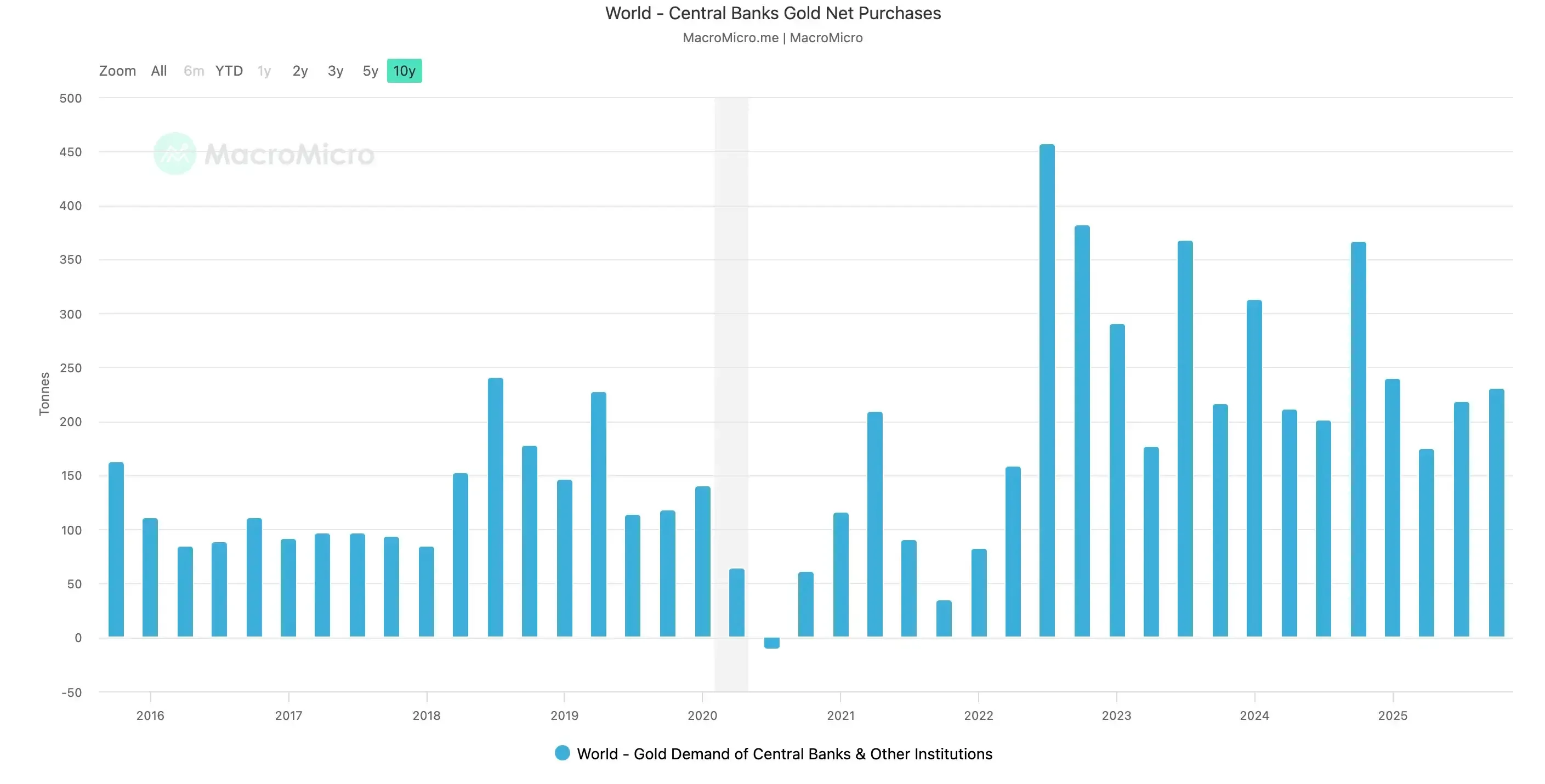
To understand why Bitcoin is currently retracing while Gold climbs, we have to look at who is doing the buying. Gold’s current strength is underpinned by a structural bid—a deep, multi-year accumulation trend from the most price-insensitive buyers in the world: central banks.
Source: MacroMicro
For the last three years, central banks have been buying over 1,000 metric tonnes of gold annually. The official sector doesn't buy Gold to 'flip' it for a 10% profit next month; they buy it to de-risk their balance sheets against long-term currency debasement. This consistent demand provides a deep, structural floor for the market, a mechanic that legacy institutions are now highlighting in their client notes. When the world’s most powerful financial institutions decide an asset is a ‘must-hold’, it creates a massive cushion of confidence that traditional investment funds eventually follow.
While Bitcoin doesn't yet have the same level of central bank ‘floor’, it is increasingly being viewed through the same lens by institutional players. The fact that Gold is reaching a theoretical long-term price target of $8,000 to $8,500 based on rising allocations is massive proof of concept for the hard-money thesis.
Bitcoin remains the high-beta version of this trade. Gold’s structural bid proves that the appetite for assets outside the traditional bond market is not a fad, but rather a shift in global finance. When the "hot money" eventually tires of the crowded Gold trade, Bitcoin sits waiting as the most liquid, scarce alternative for that capital to land.
Why the Basis Trade is Leaving Bitcoin
Bitcoin currently has a seller that Gold doesn’t: the cycle-aware long-term holder. Many experienced Bitcoin holders, acting on the muscle memory of previous four-year cycles, strategically took profits into strength late last year. This created a significant overhead supply wall that is now meeting inconsistent buying demand from the highly anticipated inflow into the institutional spot ETFs.
The drop in Bitcoin’s price can be traced back to the exit of 'fast money'; specifically, traditional finance players executing what is known as the basis trade. In simple terms, the basis trade is an arbitrage strategy where a trader buys Bitcoin (often through an ETF) and simultaneously sells Bitcoin futures to capture the difference in price between the two. Last year, as Bitcoin climbed toward its $126,000 peak, this spread was massive, offering institutional desks a ‘risk-free’ yield that far outpaced traditional bonds.
However, that opportunity narrowed. When the profit from the basis trade shrinks, this mercenary capital doesn't just sit still; it rotates. We are now seeing that capital flow directly into Gold and Silver, where new momentum and central bank activity have created fresh arbitrage opportunities. There is no immediate increased adoption story that would currently reverse this weak demand into the structural inflows needed to absorb the cyclical selling, leading to the current price stagnation.
What This Means for Bitcoin Holders
The recent price drop is largely mechanical. As basis traders unwind their positions, they must sell their spot Bitcoin (or ETF shares), creating downward pressure that isn't necessarily a reflection of Bitcoin's long-term value.
Institutional hot money is nomadic. It follows the yield. Currently, that yield is in the precious metals market, which is overbought. But with Bitcoin futures now in oversold territory, the selling pressure from these arbitrageurs is likely reaching exhaustion.
For the individual holder, it is vital to distinguish between a fundamental shift (the world deciding Bitcoin is no longer valuable) and a liquidity rotation (traders moving to a more profitable spread). The latter is a temporary headwind that often sets the stage for a catch-up trade once the Gold trade becomes too crowded.
The Coiled Spring
When an asset erases more than its year-to-date gains in a few quick weeks, the instinct is to question the thesis. However, for the disciplined holder, this divergence is a technical signal, not a fundamental failure.
The Hui-Heubel ratio—a measure of market liquidity—explains why Bitcoin’s price moves feel so much more violent than Gold’s. Bitcoin’s thinner liquidity makes it highly sensitive to order flows. While this amplifies the pain during a sell-off, it also means the recovery is typically more explosive.
We are witnessing a temporary rebalancing. Gold is leading because of a structural floor from Central Banks, while Bitcoin acts as the coiled spring waiting for liquidity to rotate back. At Xapo Bank, we view this not as a broken cycle, but as a healthy reset. Our analysis points to a reality that we have believed for a long time: TradFi is just now coming along. For those who can look past the short-term noise, the digital gold narrative remains firmly intact; it’s simply preparing for its next act.