For many, Bitcoin is a forever asset. But eventually, the real world makes a demand. A roof needs replacing, or a business needs a push. Usually, this creates a difficult choice: stay Bitcoin rich and cash poor or sell a piece of the stack.
The opportunity cost of selling: Why a Bitcoin loan might save your future gains
When you sell $50,000 of Bitcoin to cover an expense today, you aren't just trading an asset for cash; you are trading away time. This is the essence of opportunity cost. Because Bitcoin is finite, every Satoshi sold today is one that cannot grow tomorrow.
Consider a homeowner who faced a $50,000 roof repair in early 2024. At the time, with Bitcoin trading near $42,000, the repair cost them roughly 1.19 BTC.
By October 2025, Bitcoin hit a staggering cycle high of $126,000. That same 1.19 BTC was suddenly worth $149,940. By selling to cover a temporary fix, that holder didn't just pay for a roof—they paid a $99,940 liquidity tax to the market. Even today, as the market stabilizes near $71,000 following the recent drawdowns, those coins are still worth $84,490. The leak is permanent; the roof remains, but the wealth is gone.
Snapshot: The seller vs. The sovereign ($50k liquidity)
The seller (January 2024)
BTC sold: 1.19 BTC
Cash received: $50,000
Net position today: 0 BTC | $99,940 Lost Upside (at Oct 2025 peak)
The sovereign (Jan 2024):
BTC pledged: 2.38 BTC (at 50% LTV)
Loan principal: $50,000
Interest paid (2 years at ~10%): $10,000
Net position today: 2.38 BTC | Significant equity gain (even after interest)
Bitcoin tax efficiency: The logic of the unbroken stack
There is a practical, human side to this math: the tax code. In many places, selling Bitcoin is a realisation event that triggers a capital gains tax.
However, in certain jurisdictions, borrowing against an asset is typically not a taxable event. It is part of the reason why some of the wealthiest people on earth can maintain a lifestyle of hundreds of millions of dollars while reporting a taxable income that is surprisingly low. They don't aim to "avoid" taxes; they aim to optimise for time.
How billionaires use debt as a tool to reduce capital gains
It’s how individuals like Elon Musk and Jeff Bezos can fund a lifestyle of billions while paying a lower effective tax rate.
Musk famously takes no salary from Tesla. To fund his lifestyle and investments, he uses securities-based lending. In 2024, filings showed he had pledged roughly one-third of his Tesla holdings to secure personal loans. By borrowing against his shares rather than selling them, he avoids the massive capital gains tax that would come with a sale, while his shares continue to grow in value. In 2024, filings showed he had pledged roughly one-third of his Tesla holdings to secure personal loans. By borrowing against his shares rather than selling them, he avoided billions in capital gains taxes while keeping 100% of his voting power and future upside.
Similarly, a ProPublica revealed that in 2007 and 2011, Bezos paid zero in federal income taxes. He achieved this by keeping his wealth in Amazon stock and borrowing for liquidity. As long as he doesn't sell, the IRS cannot tax the unrealised gains.
By using Bitcoin collateral for a loan, the principal stays untouched. Tax can be optimised, the market upside remains, and the cash is available. Instead of spending savings, the Bitcoin stays exposed to the market.
Active portfolio management: Bitcoin as a lever
If selling is a wealth leak, then a Bitcoin-backed loan is the strategic alternative. Beyond getting cash, it’s about active portfolio management. It is the bridge between the Bitcoin you want to keep and the cash you need today.
But for the sophisticated holder, this is more than just a way to get liquidity. It is a move into active portfolio management. Unlike traditional debt, which is often a burden, a Bitcoin loan acts as a dynamic lever. It is a tool designed to move with the market, giving the holder options that simply don’t exist when you sell.
Upsizing to harvest growth: Traditional loans are static—the numbers stay the same until the end of the loan. Bitcoin loans are dynamic. If the price of Bitcoin goes up, your loan-to-value (LTV) ratio improves (it goes down). This creates a safety buffer of new equity. In many cases, this allows a holder to upsize their loan—accessing more cash against the same collateral—without a new application or a credit check. It’s harvesting the growth of the asset without selling a single Satoshi.
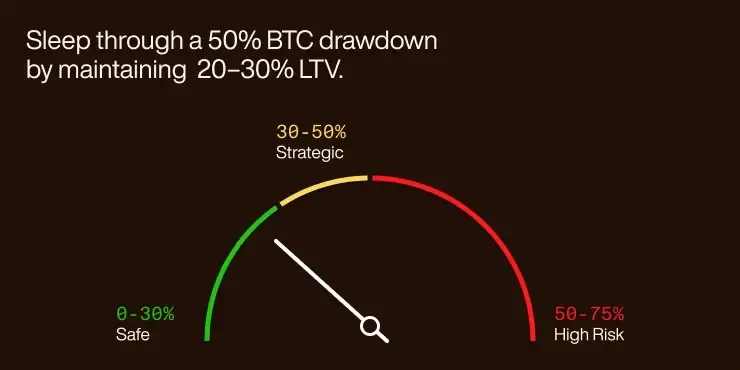
Extensions to outlast the market: Markets don’t always move on your schedule. If a loan is coming due during a temporary market dip, an extension allows the Bitcoin loan holder to stay in their position. Instead of being forced to sell at the bottom to settle a balance, the term can be extended and the holder can wait for the recovery. Time becomes an ally.
Trustless credit: Why math beats the credit score
Traditional banks rely on credit scores and personal histories. Bitcoin-backed lending is different. It’s based on the math of the collateral. It only cares about the mathematical value of the asset. Because it’s based on math, it’s instantly available, private, and requires zero credit checks. It is trustless credit, where the asset is the reputation.
The long view: Bitcoin stewardship
Ultimately, the choice between selling and borrowing is of Bitcoin stewardship.
For the accumulator, Bitcoin is more than a ticker symbol; it is a multi-generational tool designed to outlast the volatility of the present. When a life event creates a need for cash, the path of asset disposal represents a permanent reduction in one's future position. In contrast, the path of asset-based credit functions as a strategic bridge. It allows for the resolution of today’s requirements without compromising the integrity of your long-term thesis.
By choosing the math of opportunity cost and tax efficiency, you move from a defensive posture to a sovereign one. The ultimate power is choosing the mechanisms that allow you to keep.